

Packable sun protection is defined as lightweight, portable sun safety gear, including UPF-rated hats, clothing, and accessories, that folds, rolls, or crushes down small enough to carry in a diaper bag, backpack, or stroller pocket. For parents and caregivers, this category solves a real problem: children need consistent UV coverage during outdoor activities, but bulky gear rarely makes it out of the house. Understanding what is packable sun protection explained correctly means knowing both the portability standards and the UV-blocking performance behind the products you choose.
What makes sun protection truly “packable” and effective for kids?
Packable sun protection combines two distinct qualities: genuine UV-blocking performance and a form factor that travels without friction. A hat or shirt that stays in the closet because it is too stiff or bulky provides zero protection. The industry standard for UV-blocking fabric is the UPF rating, which stands for Ultraviolet Protection Factor.
UPF 50+ fabric blocks at least 98% of UVA and UVB radiation, with high-quality materials blocking 99.95% or more. That number matters because children’s skin is thinner and more sensitive than adult skin, making consistent coverage a priority rather than an afterthought.
Materials that pack well and protect well
Synthetic fabrics like nylon and polyester are the preferred choice for packable sun hats and UPF clothing. They are lightweight, quick-drying, and crush-resistant, which means they bounce back after being stuffed into a bag. Cotton, by contrast, wrinkles easily and often carries a lower UPF rating unless specially treated.
Brim width is a non-negotiable feature for children’s sun hats. A wide, firm brim of at least 3 inches shields the face, ears, and neck, which are the areas most exposed during playground time, beach trips, and sports. A baseball-style cap leaves the ears and neck completely unprotected.
Key features to look for in packable sun protection for kids:
- UPF 50+ rating on all fabric items, verified on the label
- Wide brims of at least 3 inches for hats
- Nylon or polyester construction for durability and packability
- Adjustable toggles or chin straps to keep hats on active children
- Quick-dry properties for water play and sweaty outdoor sessions
- Wrinkle resistance so gear looks and functions properly after packing
Pro Tip: Hold any fabric up to a bright light before buying. If you can see light passing through clearly, UV rays will pass through too. Dense, tightly woven fabric should show minimal light transmission, which is a quick visual check recommended by Mayo Clinic.
How does packable sun protection compare to traditional sunscreen?
Parents often treat sunscreen as the default sun safety tool, but UPF clothing and packable hats offer a meaningfully different type of protection. The comparison comes down to consistency, coverage, and convenience.
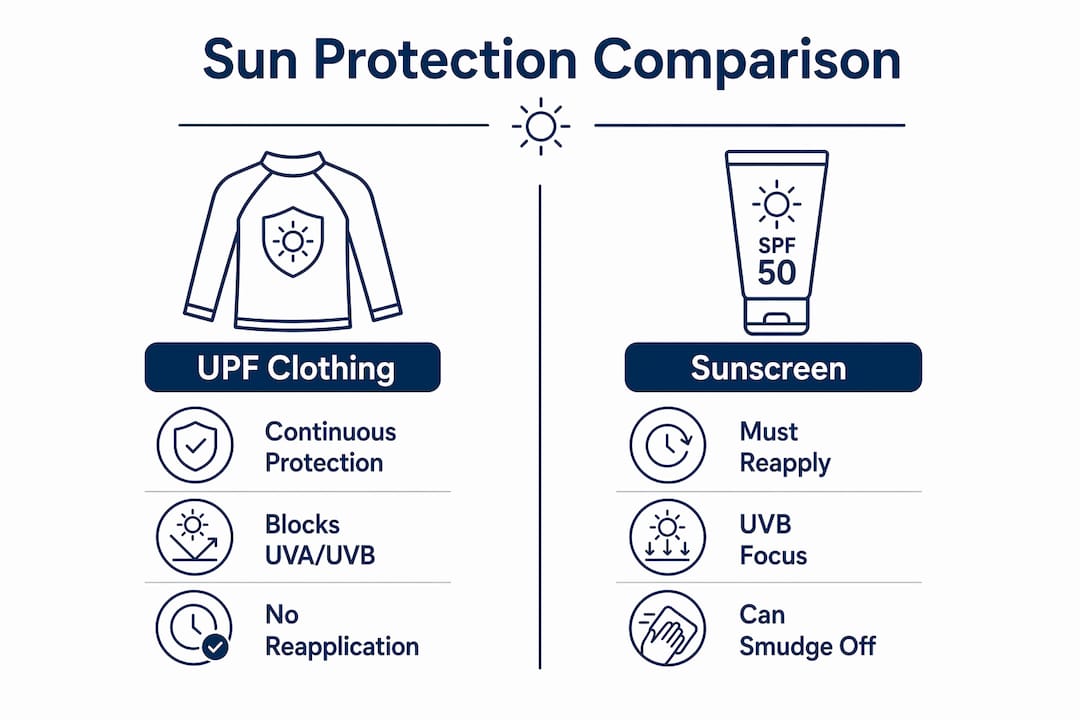
| Feature | UPF 50+ packable clothing | SPF 30+ sunscreen |
|---|---|---|
| UV coverage | Blocks UVA and UVB | Broad spectrum (UVA/UVB) with correct formula |
| Reapplication needed | No | Every 2 hours |
| Missed spots risk | Low (covers physical area) | High (easy to miss ears, neck, scalp) |
| Water resistance | Built into fabric | Degrades with water and sweat |
| Portability | Folds into bag | Bottle required, can leak |
| Cost over time | One-time purchase | Ongoing supply cost |
UPF 50+ clothing provides continuous, set-and-forget protection that covers both UVA and UVB without reapplication. Sunscreen, by contrast, requires reapplication every 2 hours and is frequently missed on areas like the back of the neck and tops of ears. For active kids who are running, swimming, and sweating, that gap in coverage is significant.
SPF 30 sunscreen blocks 97% of UVB rays, which is strong performance. The limitation is not the formula. The limitation is application. Studies consistently show that most people apply far less sunscreen than the tested amount, which drops real-world protection well below the labeled SPF.
The practical answer for parents is to use both. UPF clothing and packable hats cover the body consistently. Sunscreen fills in the gaps on exposed skin like the face, hands, and lower legs.
Practical tips for choosing and maintaining packable sun protection
Selecting the right packable gear for your child takes more than grabbing the first hat on the shelf. Fit, features, and care all affect how well the gear performs over time.
- Measure your child’s head before buying a hat. Most children’s sun hats come in size ranges by age, but head circumference varies widely. A hat that slips off provides no protection.
- Choose hats with adjustable toggles or chin straps. Active kids lose hats constantly. A chin strap keeps the hat in place during running, cycling, and beach play.
- Check the UPF label, not just the color or thickness. Dark colors absorb more UV, but only a certified UPF 50+ label guarantees the protection level.
- Test fabric with the light-transmission check. Hold the fabric up to a window. Dense, tightly woven material should block most visible light. UV rays penetrate loosely woven materials easily, reducing effectiveness.
- Use the stuff-it packing method for hats. Place soft items like socks or a rolled shirt inside the hat crown, then surround the brim with other rolled clothing. This preserves hat shape and prevents brim damage far better than folding or crushing flat.
- Wash UPF clothing according to label instructions. Some UPF treatments degrade with harsh detergents or high heat. Gentle washing preserves the rating over the garment’s lifespan.
Pro Tip: Keep a dedicated sun protection pouch in your car or stroller bag with a packable hat, a travel sunscreen, and a lightweight UPF shirt. When a spontaneous trip to the park happens, you are already prepared.
For a detailed breakdown of how to fit hats correctly for toddlers, the BANZ guide on toddler sun hat fit covers sizing and adjustment in practical terms.
How to build packable sun protection into everyday family activities
The most effective portable sun protection guide is one that fits your actual routine. Gear that requires extra steps or special handling gets left behind.
Up to 80% of UV rays penetrate clouds, and UVA rays pass through car and home window glass. Sun protection is not just a beach-day concern. It applies to school pickup, backyard play, and car rides on overcast days.
Practical ways to integrate packable sun safety into daily life:
- Time outdoor play around UV peaks. UV intensity is highest between 10 a.m. and 4 p.m. Scheduling playground time for early morning or late afternoon reduces exposure without eliminating outdoor time.
- Layer UPF clothing with sunscreen. Medical experts recommend combining multiple methods: UPF 50+ clothing, SPF 30+ broad-spectrum sunscreen, and shaded breaks. No single method covers every scenario.
- Match gear to the activity. A crushable wide-brim hat works for the beach and park. A UPF swim shirt with a packable hat covers pool days. For sports, look for UPF athletic shirts that move with the child.
- Let kids pick their gear. Children who choose their own hat color or design are more likely to wear it without resistance. BANZ offers child-friendly designs that make sun safety feel like a choice rather than a rule.
- Store gear in the car, not the closet. A packable hat stored in a glove compartment or door pocket is available for every unplanned stop. Gear in the closet stays in the closet.
Packable hats come in three main formats: roll-up, fold-flat, and crushable. Roll-up hats compress into tubes, fold-flat hats crease neatly into suitcase seams, and crushable hats bounce back naturally after being scrunched. For kids, crushable styles are the most practical because children are not careful with their gear.
For a broader look at what to pack for outdoor events, the BANZ resource on outdoor sun safety gear covers the full kit for active families.
Key takeaways
Packable sun protection is the most consistent UV defense available for active children because it requires no reapplication and covers the body regardless of how much a child moves or sweats.
| Point | Details |
|---|---|
| UPF 50+ is the standard | Choose only gear labeled UPF 50+, which blocks at least 98% of UVA and UVB radiation. |
| Wide brims matter | Hats need a brim of at least 3 inches to protect the face, ears, and neck effectively. |
| Layer with sunscreen | Use UPF clothing and SPF 30+ sunscreen together for full coverage on all exposed skin. |
| Pack smart to protect shape | Use the stuff-it method to preserve hat shape and brim integrity during travel. |
| Store gear where you use it | Keep packable sun protection in your car or stroller bag for consistent, spontaneous use. |
Why I think parents underestimate packable sun gear
By Shari M. Murphy
Most parents I talk to treat sun protection as a beach-day ritual. They apply sunscreen before a big outing and consider the job done. The reality I have seen, both in research and in practice, is that the biggest UV exposure for kids happens during ordinary days: the school pickup, the after-school park run, the Saturday morning soccer game.
The mistake I see most often is relying entirely on sunscreen while skipping physical coverage. Sunscreen is excellent, but it requires perfect application to work as labeled. A UPF 50+ hat and shirt do not require perfect anything. You put them on and they work.
The second mistake is buying packable gear and then not keeping it accessible. A crushable hat folded into a diaper bag is one of the simplest wins in child safety. It weighs almost nothing, costs less than a bottle of premium sunscreen, and provides protection that does not wash off or wear away.
The detail most parents miss is the cloud factor. UV rays penetrate clouds at up to 80% intensity. The overcast Tuesday afternoon at the playground is not a safe day without sun protection. It is just a day where the risk is less visible.
My honest recommendation: build a small sun kit that lives in your car or stroller permanently. A packable UPF hat, a travel sunscreen, and a lightweight UPF shirt cover nearly every scenario. You will use it more than you expect, and your kids will stop noticing it is there.
— Shari M. Murphy
BANZ packable sun protection for kids
BANZ builds UPF 50+ sun hats and protective gear specifically for children, starting from infant sizes through school age. Every hat is designed to be lightweight, packable, and durable enough to survive the way kids actually treat their gear.
BANZ products are trusted by over 2 million families across six continents, and the free BANZ Protect app provides real-time UV monitoring so you always know when protection is needed. If you are building a complete outdoor safety kit for your child, the BANZ Outdoor Hero bundle for ages 5–8 combines sun and hearing protection in one convenient package. For parents who want to understand the full scope of children’s safety gear, the BANZ help center FAQ covers product selection, sizing, and care in one place.
FAQ
What is packable sun protection?
Packable sun protection refers to lightweight, portable UV-blocking gear, such as UPF-rated hats and clothing, that folds or crushes small enough to carry in a bag. It is designed for consistent, on-the-go use during outdoor activities.
What UPF rating is best for children’s sun protection?
UPF 50+ is the recommended standard. It blocks at least 98% of UVA and UVB radiation and provides the highest level of fabric-based sun protection available.
Is packable sun protection better than sunscreen for kids?
UPF 50+ clothing provides more consistent coverage because it does not require reapplication and cannot be missed or rubbed off. Medical experts recommend using both together for complete protection.
How do I keep a packable hat from losing its shape?
Use the stuff-it method: fill the hat crown with soft items and surround the brim with rolled clothing in your bag. This protects the brim from bending and maintains the hat’s structure during travel.
Do kids need sun protection on cloudy days?
Yes. Up to 80% of UV rays penetrate cloud cover, and UVA rays also pass through window glass. Sun protection is necessary for outdoor and near-window exposure regardless of weather conditions.